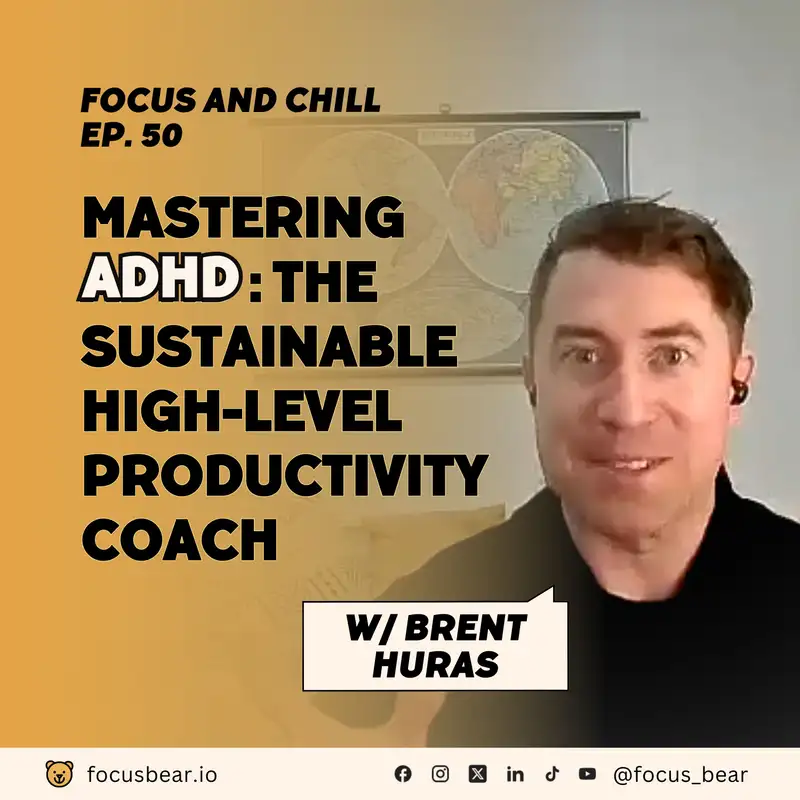
Welcome to episode #50 We’re thrilled to be joined by Brent Huras today.
Brent Huras is a Productivity & Flow State Coach whose practice evolved from the single purpose of answering the question: "How can I get myself to do my work?" To this end, he has spent the last two decades reading, studying, philosophizing - and eventually - coaching on the answer to this mysterious question. His studies have taken him along multiple paths including psychological and spiritual ones which have culminated in his body of work that he calls Sustainable, High-Level Productivity which he describes in his work on YouTube, TikTok, and blog. He currently operates out of Stratford Ontario where he serves 1-1 clients and small groups.
Welcome to the show Brent!
Questions
Can you tell us about your brain? When did you realize that your brain was different? What challenges did you face? What is it like now?
Suspected undiagnosed ADHD
Bulk of clients are people with ADHD
When they describe their experience, he felt it resonated.
Brought it up with his parents
Saw challenges in himself that wasn’t evident in his peers
Focusing at micro and macro level
Able to start but losing focus in the hour.
Or not being able to see project through to the end of the week.
How he learned the strategies
Everything leads to mastery (wanting to be really good at something)
Give himself to something so he is free to focus and go deep on something.
Reframe that he’s not missing out on something.
Developing skills/mastery opens up other opportunities further down the road.
What’s the realization like?
It was a slow realization
It’s not what you choose, it’s that you do choose.
How has your neurodivergence affected your financial life?
Family very disciplined around money
He inherited that mindset - frugal
Enthusiastic about investment opportunities
Sometimes good: early investor in BTC
Sometimes bad: bought PSYK and it didn’t go well
How has it affected your relationships?
Quick to love people
Not necessarily a bad thing - assumes positive intent.
Sees the becoming/potential.
What "work" projects are you concentrating on?
Raising toddler
1 on 1 coaching
Group Coaching
How about the rest of the time? What do you enjoy doing in your off time?
Raising toddler
Watching become a person.
Not quite like raising a cat.
There’s frequently a “new person”
Serve the evolution of humanity
Signaling to other people that it’s ok to step into purpose.
Coaching
Wisdom traditions
Practices of enlightenment and awakening.
Deeper and more grounded layers of peace.
Playing piano.
What forms of exercise do you do?
Gym 3x a week
Get a run in per week
Ken Wilbur’s stuff
Meditation and working out complement each other.
What does your morning routine look like and how has it evolved over time?
Try and wake up before daughter
Do meditation
Catching up later in the day
Find a time to meditate ideally before the morning
Ideal routine (past routine)
Get up
Meditate
Exercise
Shower
Journaling
Prioritizes mindfulness throughout the day
Mindfulness is not just on the meditation cushion - be mindful when leaving a room, getting into the car etc.
What do you do to optimize productivity during your working hours?
Getting self to do the thing:
Flow state
Remove the judgment that some tasks are flowy and others are tedious (e.g. doing tax return can be fun)
“Compressed ease” - expectation that it should be going faster
It will take as long as it will take
Slow down - let it take as much time as needed
COMMERCIAL BREAK
What is one bad habit you have removed from your life (either a bad habit or one that takes up too much time)?
Smoking cigarettes + Drinking
What’s your sleep like?
No sleep issues, sleep well.
Toddler wakes them up sometimes.
How do you switch off at night?
Trust that there is nothing to think about right now.
What resources (books, philosophies, apps, sensory toys) do you find most helpful for dealing with your brain?
Books:
Falling into Grace - A.. Shanti QQQ
The power of now
The universe always has a plan Matt Kahn
Where can people connect with you or find your work?
Do you have any final words or asks for our audience?
Radical self-trust: notice when the brain tells you that you’re missing something/doing something wrong. Suggest to yourself that you know what you’re doing.

 Episode 49