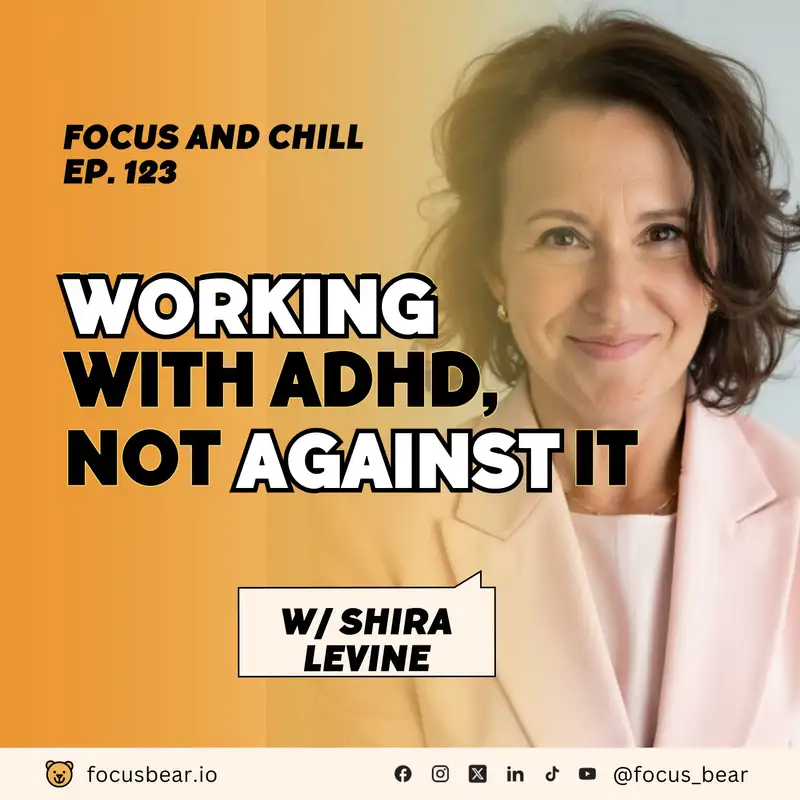
What does ADHD actually feel like in your body and mind?Shira Levine was diagnosed in the 1980s — and describes the moment medication helped her feel grounded for the first time.
Shira is a Silicon Valley–trained marketing and customer engagement strategist with decades of experience in retention, loyalty, and community-driven growth. Diagnosed with ADHD as a teenager in the 1980s, she brings a rare long-term perspective on neurodiversity, work, creativity, and self-acceptance.
Episode Highlights:00:06:30 — What ADHD feels like in the body Shira describes living with ADHD as walking on pavement covered by a thin layer of water — never fully grounded. Medication didn’t “fix” her, but helped her finally feel present and connected to the world.
00:17:20 — Productivity, dragons, and scope creep She explains how neurodivergent people often solve problems that aren’t theirs to solve. Learning when to say no became essential to doing meaningful work.
00:18:45 — Ruthless prioritization without shame Shira reframes prioritization not as discipline, but as protection against overwhelm. Seeing too much can be a strength — if boundaries exist.
00:29:00 — Why she rejects minimalism Minimalism and rigid productivity systems never worked for her ADHD brain. She gives explicit permission to reject trends that create more shame than clarity.
00:30:30 — Fidgets, movement, and regulation From shells to paper clips, Shira explains how keeping her hands busy helps her stay present. Regulation, not stillness, is the goal.
00:33:00 — Designing tools for real ADHD lives She describes the need for multidimensional timers that match how neurodivergent people actually multitask. ADHD isn’t a failure of focus — it’s a different operating system.
00:35:30 — Night routines and protecting sleep Putting her phone on another floor and reading fiction nightly helped Shira become a “gold medal sleeper.” Structure supports rest, not restriction.
00:38:00 — A simple mental exercise for racing thoughts Listing seven things seen and seven things done becomes a grounding practice when sleep feels impossible. Focus follows structure.
00:40:30 — Self-acceptance, obsession, and dialing it down Shira reflects on learning to work
with ADHD rather than against it. Obsession and intensity aren’t flaws — the work is knowing when to modulate them.
Connect with Shira:
LinkedIn: https://www.linkedin.com/in/supershiralevine
Website: https://fanchismo.com/
Connect with Jeremy:
LinkedIn: https://linkedin.com/in/nageljeremy
Email: jeremy@focusbear.io
More from Focus Bear:
Website: https://focusbear.io
LinkedIn: https://www.linkedin.com/company/focus-bear/
Youtube: https://www.youtube.com/@focusbearapp
Twitter: https://twitter.com/focusbear1
Instagram: https://www.instagram.com/focus_bear/
Facebook: https://www.facebook.com/focusbearapp/
Podcast: https://podcast.focusbear.io
Tiktok: https://www.tiktok.com/@focusbear

 Episode 123